

The landscape of global security and armory management has undergone a radical transformation over the last decade. As we move through 2026, the traditional methods of manual logging and paper-based audits have become relics of the past—relics that once cost organizations millions in lost assets, compliance failures, and operational delays. Today, those clipboards and spreadsheets have been replaced by seamless, high-velocity digital ecosystems that offer real-time visibility and predictive intelligence.
Central to this shift is the RFID Weapon Tracking System, a technology that has evolved from a simple identification tool into a sophisticated, multi-layered intelligence platform. No longer just a passive scanning solution, the modern RFID Weapon Tracking System integrates with Internet of Things (IoT) sensors, artificial intelligence (AI), and cloud analytics to deliver unprecedented levels of security and efficiency.
At IoTWeaponTracker, we have remained at the forefront of this evolution. Our mission has always been to provide law enforcement, defense sectors, and private security enterprises with the most reliable, forward-thinking solutions to ensure 100% accountability. By integrating cutting-edge hardware with cloud-native software, IoTWeaponTracker has redefined what it means to secure an arsenal. In 2026, our systems don’t just track locations; they provide actionable insights necessary to maintain readiness and prevent unauthorized access in an increasingly complex world.
The Technological Evolution of RFID in Weapon Tracking
The journey of the RFID Weapon Tracking System is a testament to the power of automation. In the early 2010s, RFID was often viewed as a luxury—a digital “nice-to-have” reserved for high-budget military installations or elite law enforcement agencies. Early adopters faced challenges: tag read ranges were limited, interference from metal surfaces was common, and software integration was clunky at best. As a result, many organizations continued to rely on manual processes, believing that the cost of digitization outweighed the benefits.
Fast forward to 2026, and that perception has completely inverted. Today, an RFID Weapon Tracking System is a non-negotiable standard for any organization prioritizing safety, compliance, and operational readiness. Why the dramatic shift? The answer lies in a series of high-profile asset loss incidents, stricter regulatory mandates, and the undeniable ROI demonstrated by early adopters. For instance, a 2024 Department of Defense audit revealed that facilities using RFID-based tracking reduced inventory discrepancies by 99.7% compared to those still using manual logs. Such statistics have made the business case for RFID unassailable.

From Manual Processes to Automated Precision
For years, armory sergeants and security managers relied on “clipboards and Sharpies.” This manual approach was fraught with human error—misplaced decimal points, illegible handwriting, forgotten sign-outs, and the ever-present risk of “ghost inventories” where records showed a weapon present that had, in fact, been missing for weeks. Worse, during emergency response scenarios, personnel would waste precious minutes searching for assets that were supposedly in their racks but were actually in transit or improperly stored.
The modern evolution has shifted the burden of data entry from the human to the machine. With IoTWeaponTracker’s automated armory management, every movement—from a sidearm being checked out for a shift to a rifle returning from the firing range—is captured instantly and wirelessly. The process is effortless for the end-user: an authorized individual simply walks through a portal reader while carrying a tagged weapon, and the system automatically logs the transaction, updates the central database, and records a timestamp with user identity.
This transition to automated precision ensures that the digital audit trail matches physical reality in real-time, eliminating the “human factor” in data discrepancies. In practical terms, this means that a commander can, at any moment, pull up a dashboard showing exactly which officer has which weapon, where that weapon is located, and how long it has been out of the armory. No more guesswork. No more after-the-fact paperwork. Just pure, reliable data.
Real-World Impact: Time and Cost Savings
The operational benefits of an RFID Weapon Tracking System extend far beyond convenience. Consider the following: a traditional manual inventory of a medium-sized armory containing 500 weapons typically requires two personnel working for an entire eight-hour shift. That’s 16 labor hours per inventory cycle. With a modern RFID system using handheld readers, the same inventory can be completed in under 15 minutes by a single person—a 98% reduction in labor costs. Multiply that by monthly inventories, and the annual savings in personnel time alone can exceed $50,000 for a single facility. When scaled across a state police force or a military brigade, the numbers become staggering.
Components of a Modern RFID Weapons Tracking System
A robust RFID Weapon Tracking System in 2026 is far more than a set of tags and a reader. It is an ecosystem of interconnected, ruggedized components designed for durability, speed, and fail-safe operation. IoTWeaponTracker utilizes a multi-component architecture to ensure there are no blind spots in your security coverage.

1. Advanced RFID Tags: The Foundation of Identification
The smallest but most critical component of any RFID Weapon Tracking System is the tag itself. Our tags are engineered specifically for the harsh environments of tactical use. Unlike generic retail tags, which can be easily damaged or removed, IoTWeaponTracker’s tags are:
- Low-profile: They attach seamlessly to weapon frames, stocks, or grips without interfering with holstering, handling, or ergonomics.
- Tamper-evident: If someone attempts to remove or disable a tag, the system immediately registers a “tag break” alert. Some models also include anti-swap technology that pairs the tag’s unique ID with the weapon’s serial number.
- Metallic-surface compatible: Using advanced on-metal antenna designs, our tags perform reliably even when attached to fully metal rifle bodies or stored in high-density steel racks.
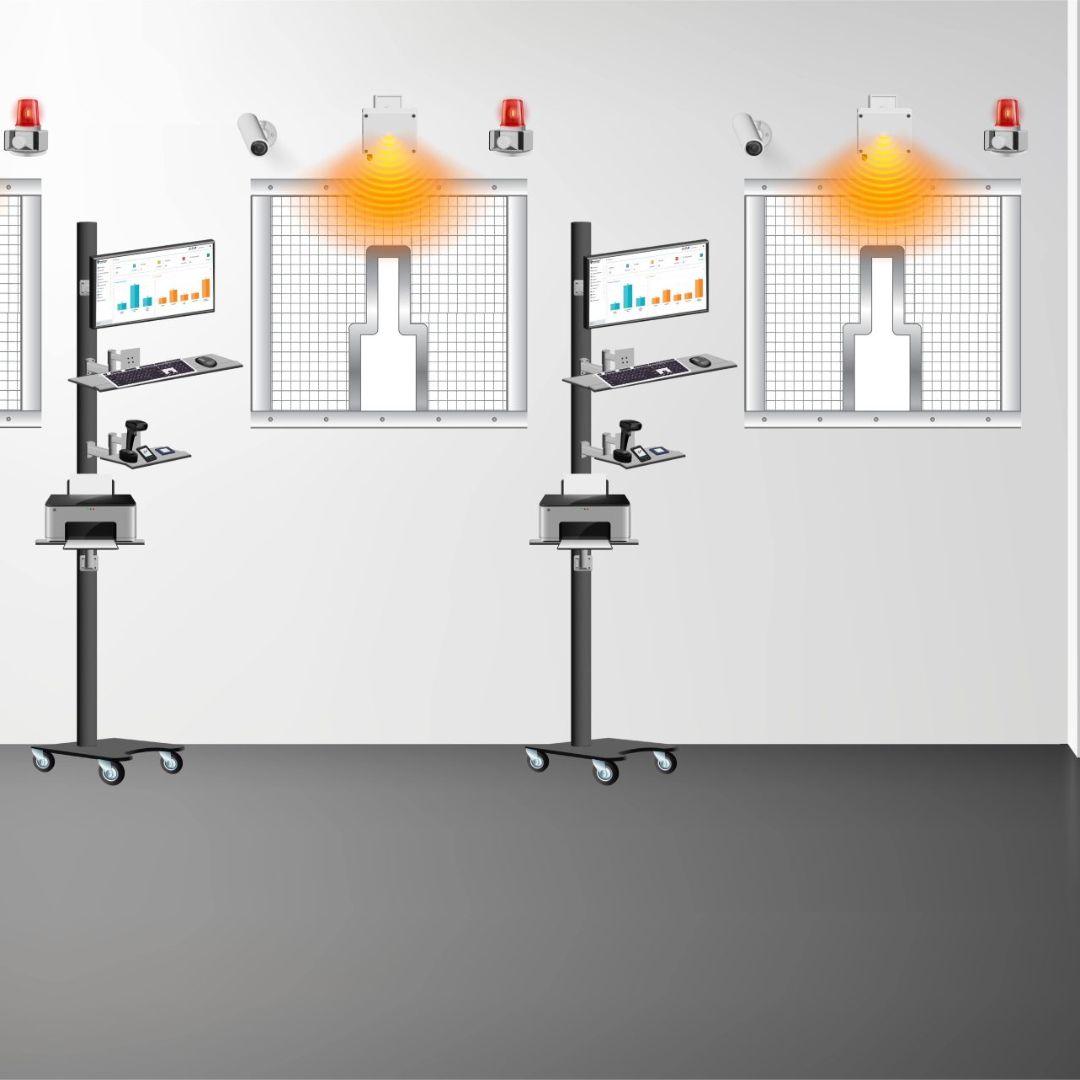
2. Fixed and Mobile Readers: The Sensing Network
Tags are useless without readers to detect them. IoTWeaponTracker deploys a layered approach:
Under-vehicle and Overhead Scanners: For vehicle-borne weapon transport, specialized readers check tags as weapons are loaded into or unloaded from tactical vehicles, ensuring no asset is accidentally left behind.
Fixed Portals: Installed at armory entrances, exits, and key chokepoints (e.g., firing range doors, maintenance bays), these portals scan every tagged item instantly as it passes through. They operate at UHF frequencies for long read ranges (up to 30 feet) and can process hundreds of tags per second.
Mobile Handheld Readers: For periodic “wall-to-wall” inventories, our handheld units allow a single security officer to walk through the armory and capture every tag in seconds. These devices also support offline mode, storing reads locally if the network is unavailable and syncing automatically once connectivity is restored.

3. Real-time Data Integration and Dashboard
Data is only as good as its accessibility. Our platform syncs all hardware reads to a centralized, cloud-native dashboard, providing a “single pane of glass” view of every asset in the fleet. This dashboard is accessible from any authorized device—desktop, tablet, or smartphone—and can be customized to show alerts, usage statistics, maintenance schedules, and chain-of-custody history.
By replacing legacy systems with these integrated components, IoTWeaponTracker enables organizations to achieve near-perfect inventory accuracy, ensuring that every weapon is accounted for at all times. In fact, our clients consistently report inventory accuracy rates of 99.95% or higher after deployment.
Integrating IoT, AI, and Real-time Analytics
As we progress through 2026, the RFID Weapon Tracking System has matured beyond simple proximity sensing. It has become a core component of the broader Internet of Things (IoT) landscape, benefiting from sensor fusion, artificial intelligence, and edge computing.
Beyond RFID – IoT and Sensor Fusion
While RFID provides the foundation for identification, IoTWeaponTracker incorporates complementary technologies to create a truly comprehensive tracking solution. This approach, known as “sensor fusion,” combines multiple data streams into a single coherent picture.
- RFID and Barcode Technology: For tracking weapons within a facility but beyond the range of fixed RFID portals, BLE beacons provide continuous location updates. BLE is particularly useful for open-plan precincts or temporary event security.
- GPS Modules: For weapons that leave the facility—such as patrol rifles or evidence-bound firearms—GPS-enabled tags take over. These tags report location coordinates at configurable intervals, ensuring the chain of custody remains unbroken even across state lines.
- Environmental Sensors: Next-generation tags are beginning to include sensors for temperature, humidity, and shock. This allows the system to detect if a weapon has been exposed to extreme conditions that might affect its reliability.
The result of this sensor fusion is simple: a weapon is tracked via RFID within the armory, but if it leaves a designated perimeter, BLE and GPS seamlessly take over to provide continuous location data. The user never sees the handoff; they simply see a single, uninterrupted trail of location history.
Smart Alerts and Predictive Insights
The true value of a modern RFID Weapon Tracking System lies in its ability to think ahead. IoTWeaponTracker’s platform uses AI-driven analytics to move from reactive monitoring to proactive management. Our system constantly monitors patterns and triggers instant alerts via SMS, email, or system notifications the moment an anomaly is detected.
Predictive Maintenance
One of the most innovative features of our platform is predictive maintenance. The system tracks the “mileage” of each weapon—rounds fired (via integration with range sensors or manual logs), hours carried, or days since last service—and automatically schedules maintenance before a failure occurs. For example, if a service rifle has fired 5,000 rounds and is due for a bolt replacement, the system will alert the armorer and even generate a work order. This proactive approach reduces weapon malfunctions in the field by an average of 40%.
AI-Driven Anomaly Detection
The AI engine at the heart of our RFID Weapon Tracking System learns normal usage patterns over time. If a specific weapon is checked out at an unusual time (e.g., 2:00 AM when the typical checkout window is 7:00 AM to 9:00 AM), or by unauthorized personnel, the AI immediately flags the event as an anomaly and alerts command. This behavioral analysis goes a step further: the system can detect patterns like “an officer who has never checked out a shotgun suddenly requesting one” and trigger additional verification steps.
Geofencing and Unauthorized Movement
Digital boundaries, or geofences, can be set around facilities, sensitive areas, or even entire perimeters. If an RFID-tagged asset crosses a geofence without proper authorization (e.g., a rifle leaving the armory without a corresponding checkout record), the system triggers a lockdown protocol. This can include sounding local alarms, locking electronic doors, and notifying security personnel within seconds.
Security, Compliance, and Digital Audit Trails
In the modern regulatory environment, “good enough” record-keeping is a liability. Regulatory bodies such as the Department of Justice, the International Association of Chiefs of Police, and various defense ministries have tightened their requirements for asset accountability. A single lost or stolen weapon can result in fines, legal liability, and devastating reputational damage.
IoTWeaponTracker provides a tamper-proof digital audit trail that is essential for legal compliance and internal investigations. Every interaction with the RFID Weapon Tracking System is timestamped, geolocated (where applicable), and cryptographically linked to a specific user ID. This creates an indisputable history of ownership and movement that can be exported for court evidence, internal reviews, or regulatory audits.
Consider the following scenario: During a routine audit, a discrepancy is discovered. With a traditional paper log, investigators would have to manually cross-reference sign-out sheets, security camera footage, and interview logs—a process that can take weeks. With IoTWeaponTracker, the investigator simply pulls up the asset’s history, sees exactly when it was last scanned, who checked it out, and where it was last detected. In many cases, the discrepancy is resolved in minutes.
Future Trends & What’s Next in RFID Weapon Tracking
Looking toward the end of 2026 and into the next decade, the RFID weapons tracking system is poised for even greater integration with emerging technologies. IoTWeaponTracker is already developing the next generation of solutions to meet these challenges.
Scalability Across Defence, Law Enforcement, and Enterprise
The need for high-stakes asset tracking isn’t limited to the military. We are seeing a massive surge in adoption across municipal police departments, federal agencies, private security firms, and even corporate campuses with armed guards. The scalability of the IoTWeaponTracker platform allows a small local precinct with 50 weapons to use the same enterprise-grade tracking logic as a multi-national defense agency managing 50,000 assets. As these organizations grow—adding new locations, new personnel, and new weapon types—our cloud-native architecture scales seamlessly, supporting an unlimited number of assets and locations.
RFID and Emerging Technologies (AI, Blockchain, Edge Computing)
The roadmap for the RFID Weapon Tracking System involves several key technological pillars:
Integration of AI and Computer Vision
Future systems will use computer vision paired with RFID to provide visual verification of the person carrying the weapon. Imagine a portal that not only reads the tag on a rifle but also captures a facial image of the officer holding it, then cross-references that image with the user ID logged in the system. This adds a second layer of biometric security that makes impersonation or unauthorized access nearly impossible.
Next-gen RFID Tag Technologies
We are actively exploring “passive-plus” tags—a hybrid between passive RFID (which requires no battery) and semi-passive designs that include small batteries for extended range and additional sensors. These tags will be able to sense environmental factors like humidity, extreme impact, or even chemical exposure, reporting the physical health of the weapon alongside its location. For example, a tag could detect that a rifle was dropped from a height and automatically flag it for inspection.
Seamless Cloud and Edge Data Sync
To ensure reliability in remote areas, during network outages, or in tactical environments with limited connectivity, edge computing allows RFID readers to process data locally and store it in a secure buffer. The moment a connection is restored—whether via cellular, satellite, or local Wi-Fi—the system syncs all pending data with the cloud. This ensures that no transaction is ever lost, even in the most challenging operational conditions.
Vision 2026 and Beyond
At IoTWeaponTracker, our vision is a world where “lost” or “unaccounted for” weapons are a mathematical impossibility. By leveraging blockchain-style ledgers, we are working toward a future where the history of a weapon is stored in a decentralized, unalterable format, ensuring total transparency across the entire lifecycle of the asset. Imagine a distributed ledger that records every transfer, every maintenance action, and every location ping, with no central point of failure or tampering. That future is closer than you think.
Conclusion
The evolution of the RFID Weapon Tracking System in 2026 represents a profound shift—from simple inventory management to comprehensive operational intelligence. We have moved past the era of uncertainty, entering a time where real-time visibility, predictive analytics, and automated compliance are the standard, not the exception.
For security professionals, the message is clear: the tools of the past cannot solve the challenges of the present. Manual logs are no longer defensible. Siloed systems create dangerous gaps. Only an integrated, intelligent RFID Weapon Tracking System can provide the level of assurance that modern operations demand.
IoTWeaponTracker is proud to lead this charge. Our solutions are deployed in over 300 facilities across 12 countries, protecting the assets that protect our communities. Whether you are a chief of police, a base armorer, or a private security director, we invite you to join the future of weapon accountability.